
Complete Cob Cabaña in Vichada, Colombia
January 24, 2027 ∞ 4:00 pm - February 28, 2027 ∞ 4:00 pm
$2500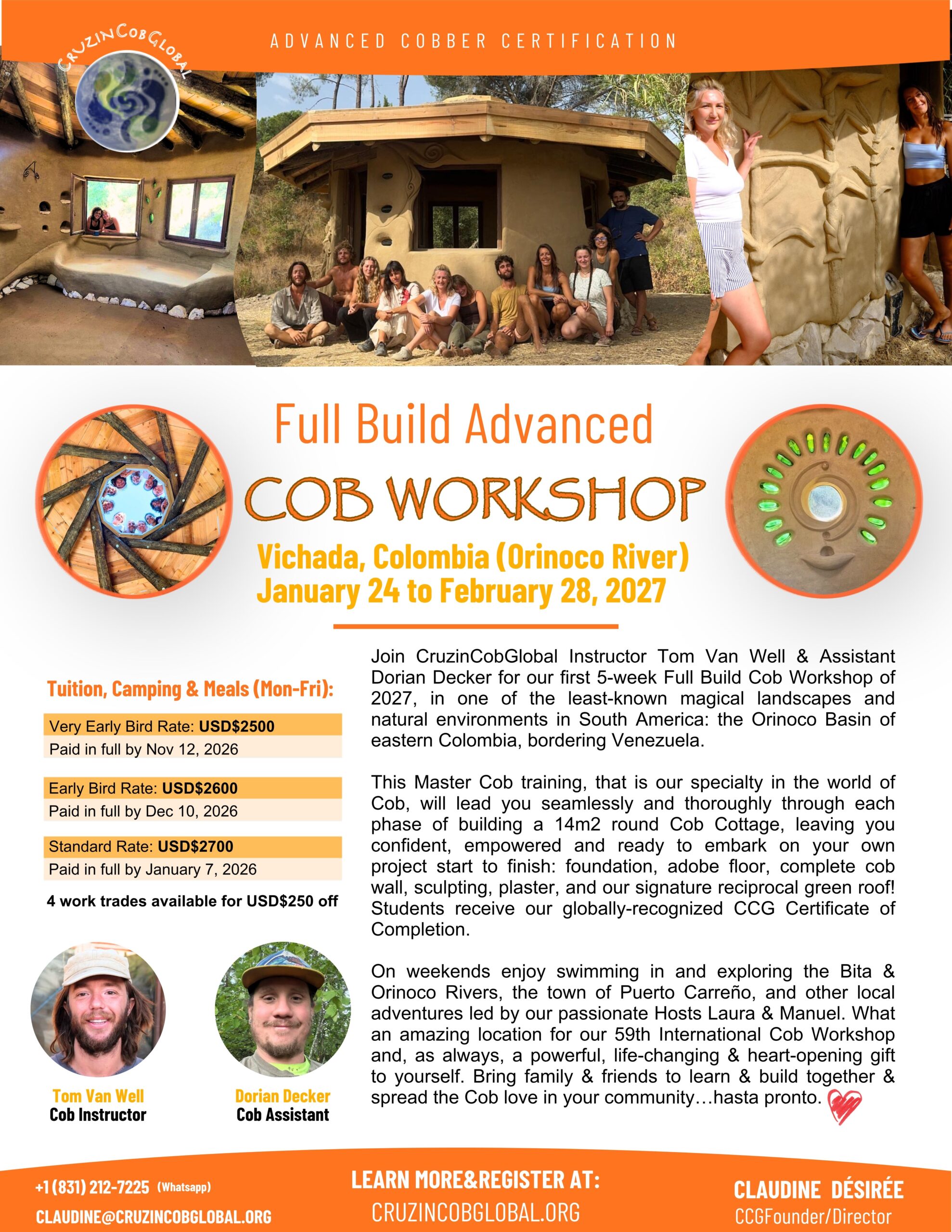
THE PROJECT
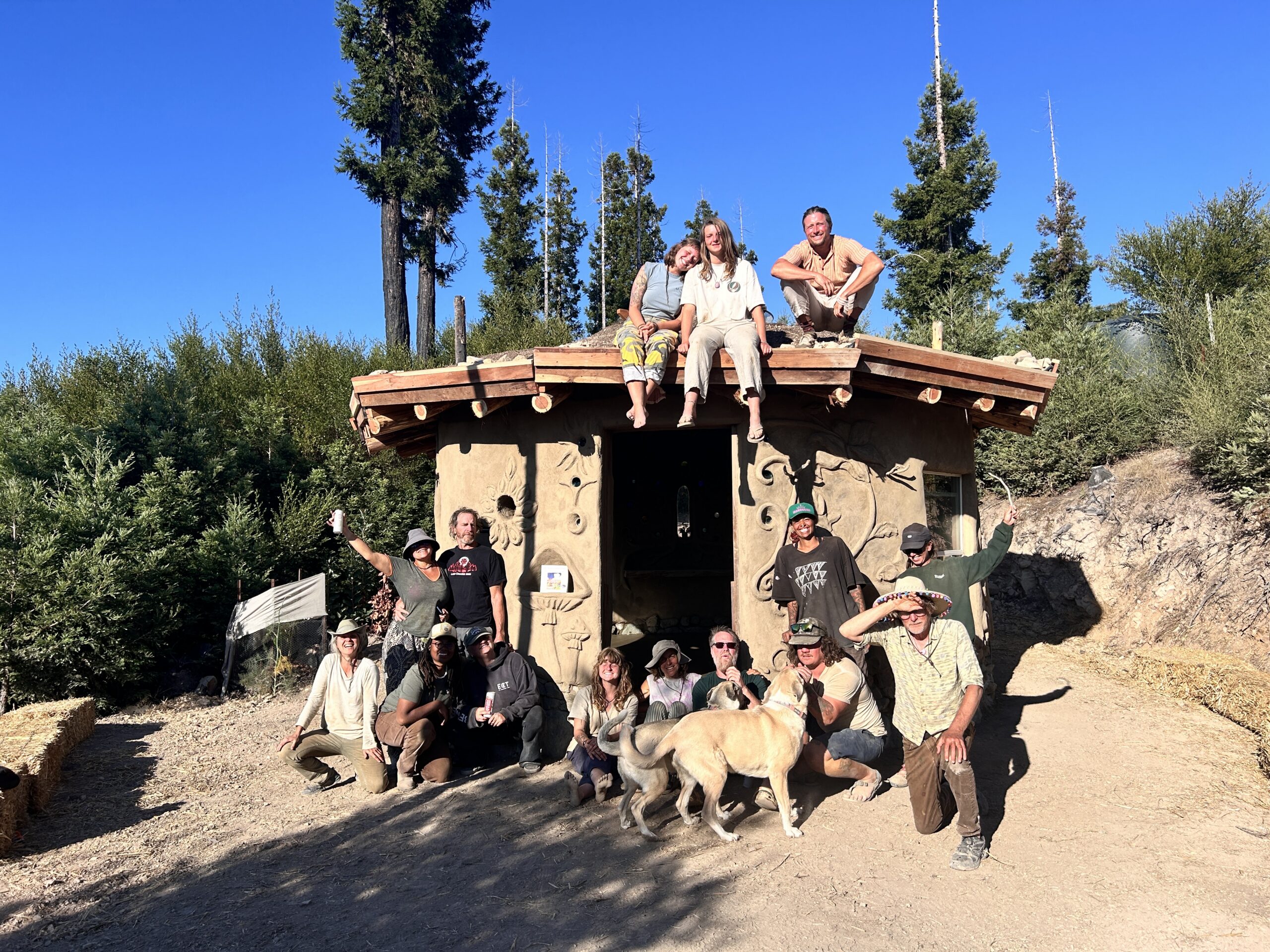
2026 California Workshop students
Workshop students will be building the first COB structure on this sacred savanna land and the future center for sustainable living education in this area of Colombia. We are very excited to collaborate with Laura & Manuel as they start off their new Soul- and Heart-led life by being the first to introduce COB to this area of the country, and hosting our intimate, sacred and soulful way of building in community, with 12-15 pairs of loving and passionate muddy hands and feet. Starting with the “boots”, the stone foundation, to the “hat”, our indestructible, gorgeous signature reciprocal green roof, we will cover EVERYTHING important in between! You will leave absolutely giddy, confident, transformed, inspired, motivated, excited, and ready for more. Be prepared for a total life makeover, and renewed strength and empowerment to fearlessly lead a life TRUE to YOU! We see this in every workshop year after year. It’s called “Cob Therapy” and it happens organically whether you intend it or not:)
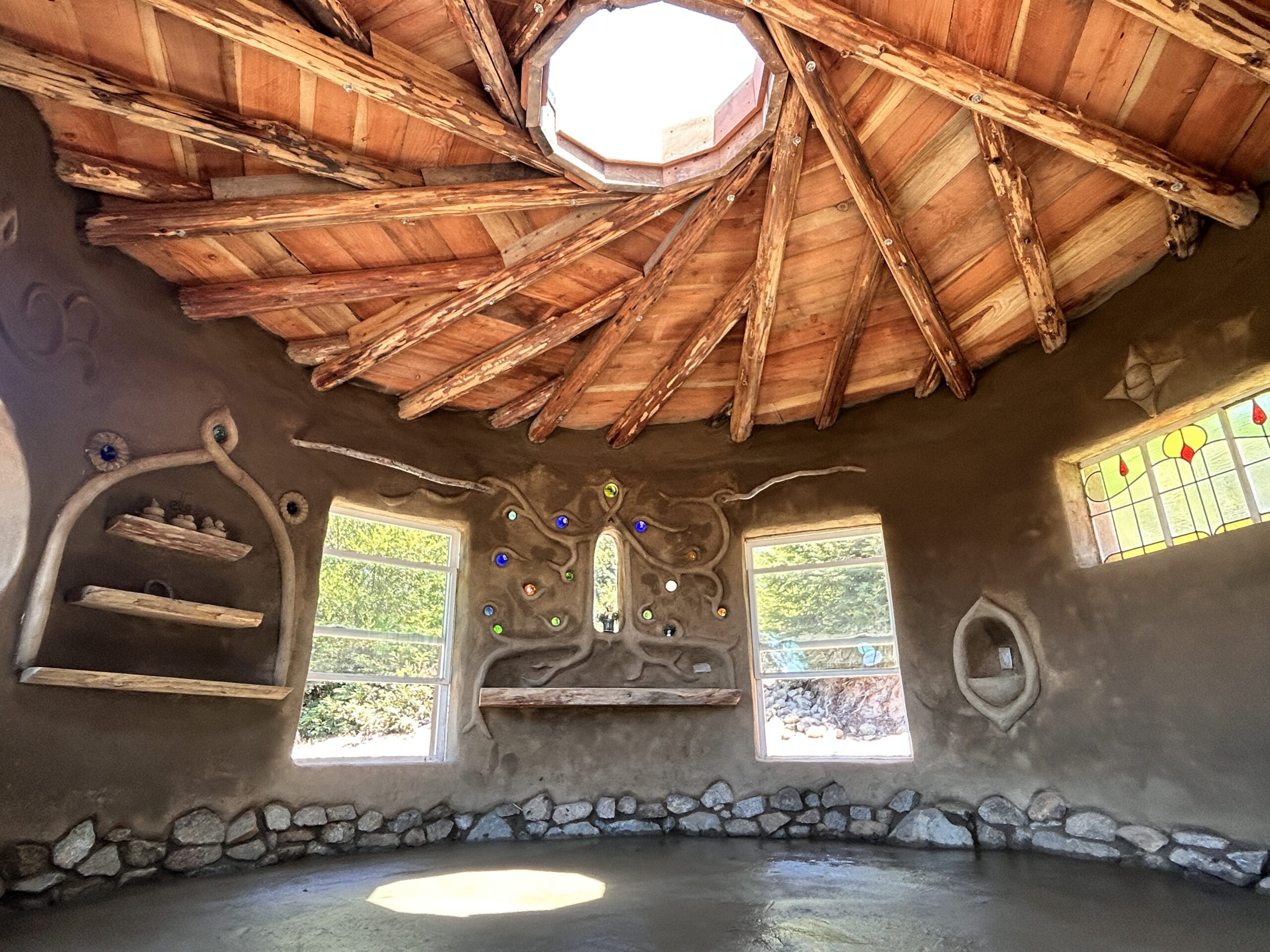
California Reciprocal Roof built with fire-salvaged redwood poles, 2026
We will be building a 14m2/154ft2 round building (final size dependent on number of students). The breathtaking reciprocal roof structure we build in all of our workshops is the strongest roof there is, due to its interlocking spiral structure, which holds itself up with no outward push on the monolithic round wall of the building. In addition, it mirrors the horizontal social structure favored in indigenous societies, who meet under these types of roofs for Council Circles. In CruzinCobGlobal workshops, students also meet weekly in Council Circle throughout the workshop, to support all the inner and outer work they experience, by having the opportunity to share and listen to others’ shares.
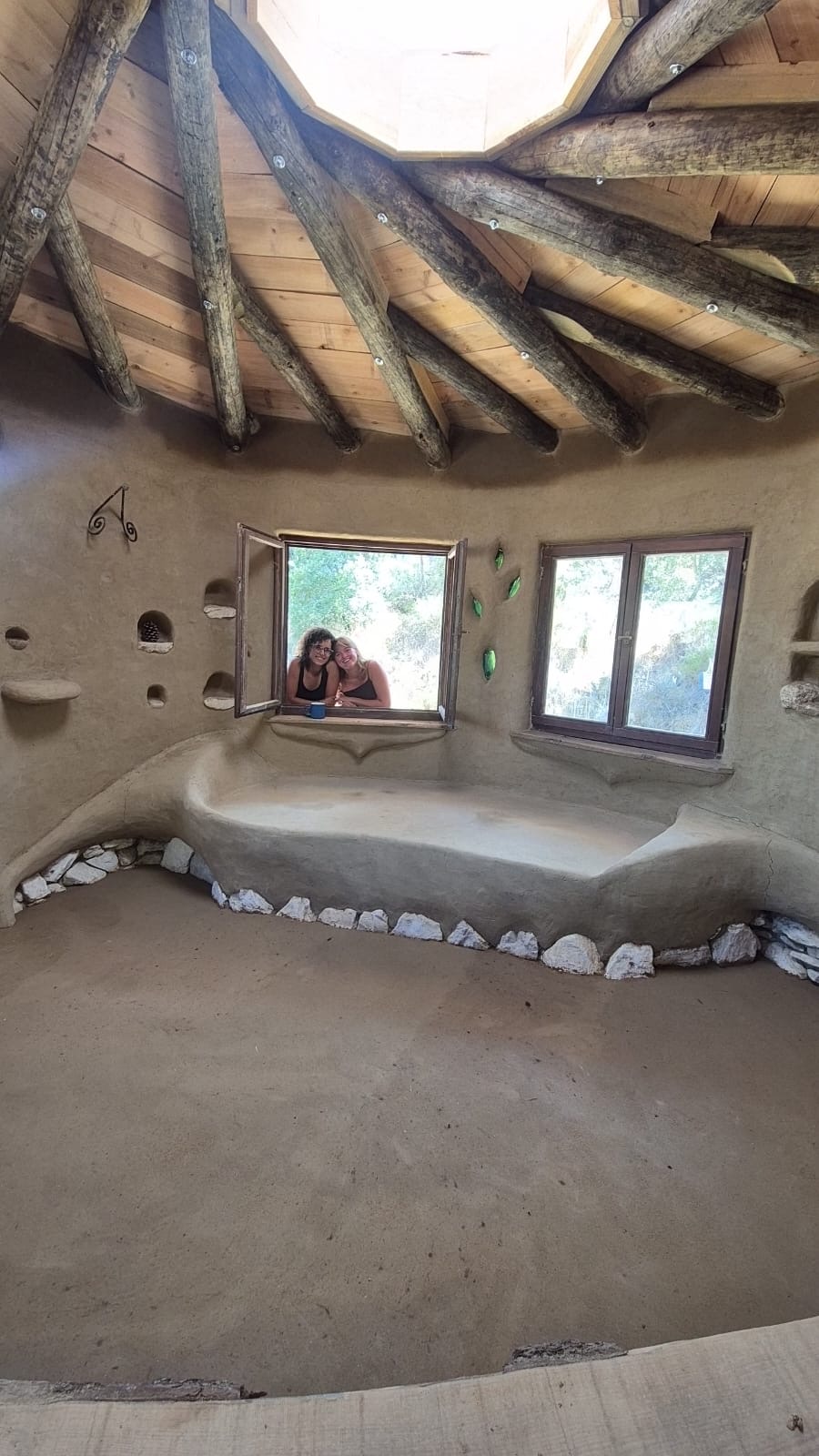
Bliss of a finished Cob building in Coruche, Portugal, 2026
Students in this Advanced Cobber Certification training will, as always, learn all the steps to building a complete Cob Building from scratch. In week 1, we dig the foundation trench and fill it with landscape cloth-wrapped drainage rock/gravel followed by a sturdy30cm-wide aesthetic natural stone stemwall to support the cob wall and roof. We finish the week off by pouring the first rough layer of adobe/cob floor on a layer of insulation (if appropriate) underlain by a gravel drainage base. We wrap up the week with the installation of the door frame with braces and stakes to hold it in place as we start the cob wall. In weeks 2 & 3, we build the monolithic cob wall, layer by layer, with all its detailed insertions (windows, shelves, electrical housing, hooks, niches, bottles, desk/counter, anchors and roof connectors), and finish week 3 off with 2 days of relaxed sculpting. In week 4 we plaster our beautifully-decorated and solid wall with an earthen and fermented manure scratch coat mix. On that Friday, following an introduction to the roof on Thursday evening, we practice setting up the roof on the ground several times in the morning. After lunch, we build and install the Reciprocal Roof primary rafter structure onto the wall. In our final week, we complete the roof structure and sheathing/decking to support the impermeable Green Roof covering, which goes on on Wednesday or Thursday. In the final days of week 5, we will close the top of the cob wall to the ceiling and pour the smooth and finer second finish adobe floor coat. The work may continue through Saturday morning if needed, to insure a complete site clean-up before the building is revealed to the local community. The last Saturday evening, students will enjoy a Graduation ceremony after the Hosts’ Celebration/Gratitude dinner on Saturday evening. Sunday morning is our Closing Circle followed by our final Brunch/Lunch together and before the afternoon public Open House, when the final project is revealed to the outside world!
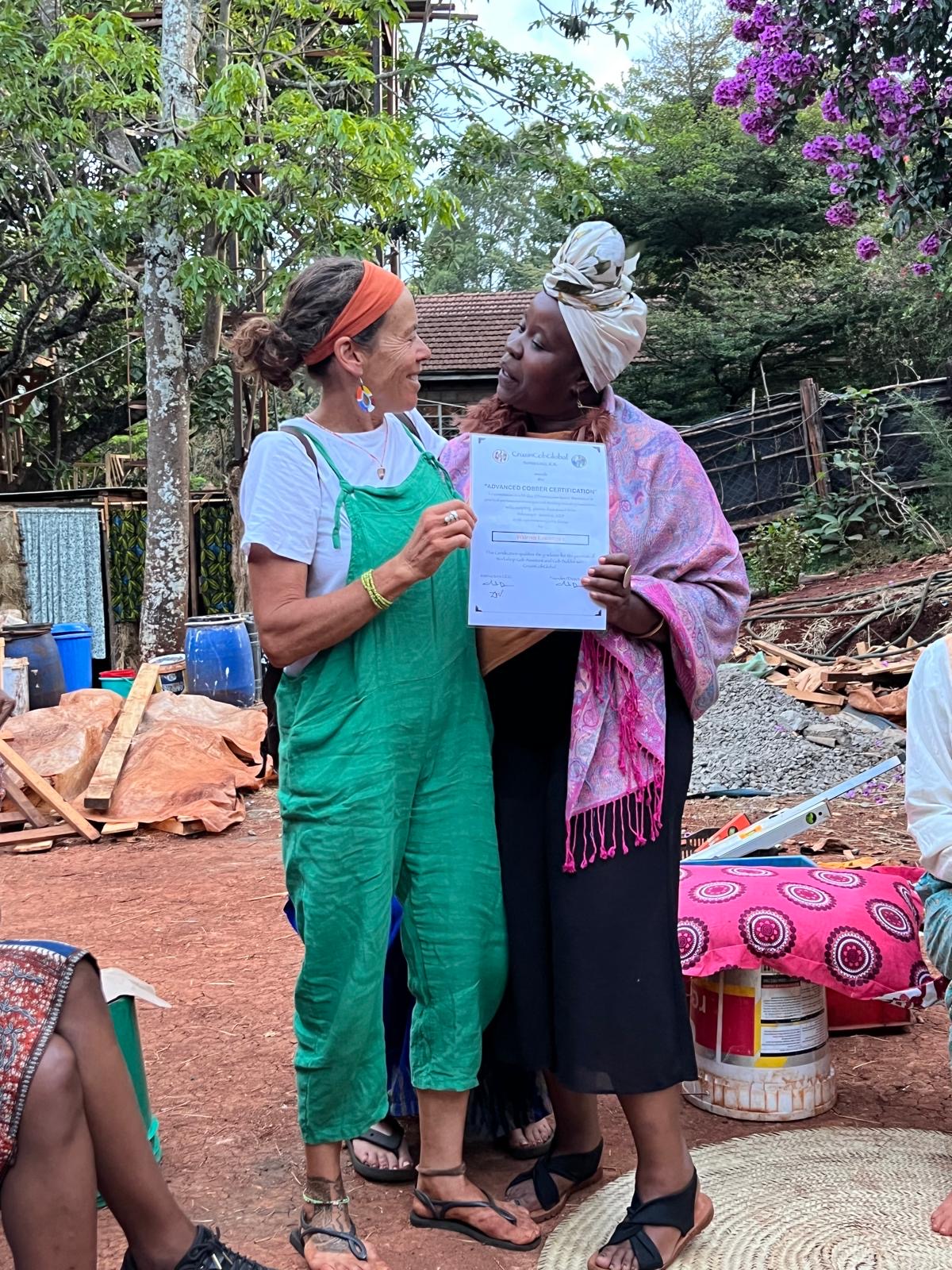
Graduation in Kenya, 2025
ADDENDUM
CCG has taught in many countries of the world and our mission is to create access to everyone interested, especially the local people, so we can create international cob building families where all students grow and learn on a personal and interpersonal level. We aim to create intercultural and interhuman bonding experiences through our Cob building workshops to heal the world one Cob house at a time. So please follow your Heart & Soul, if this life-changing adventure is calling to you in 2027!
DETAILED WORKSHOP DESCRIPTION
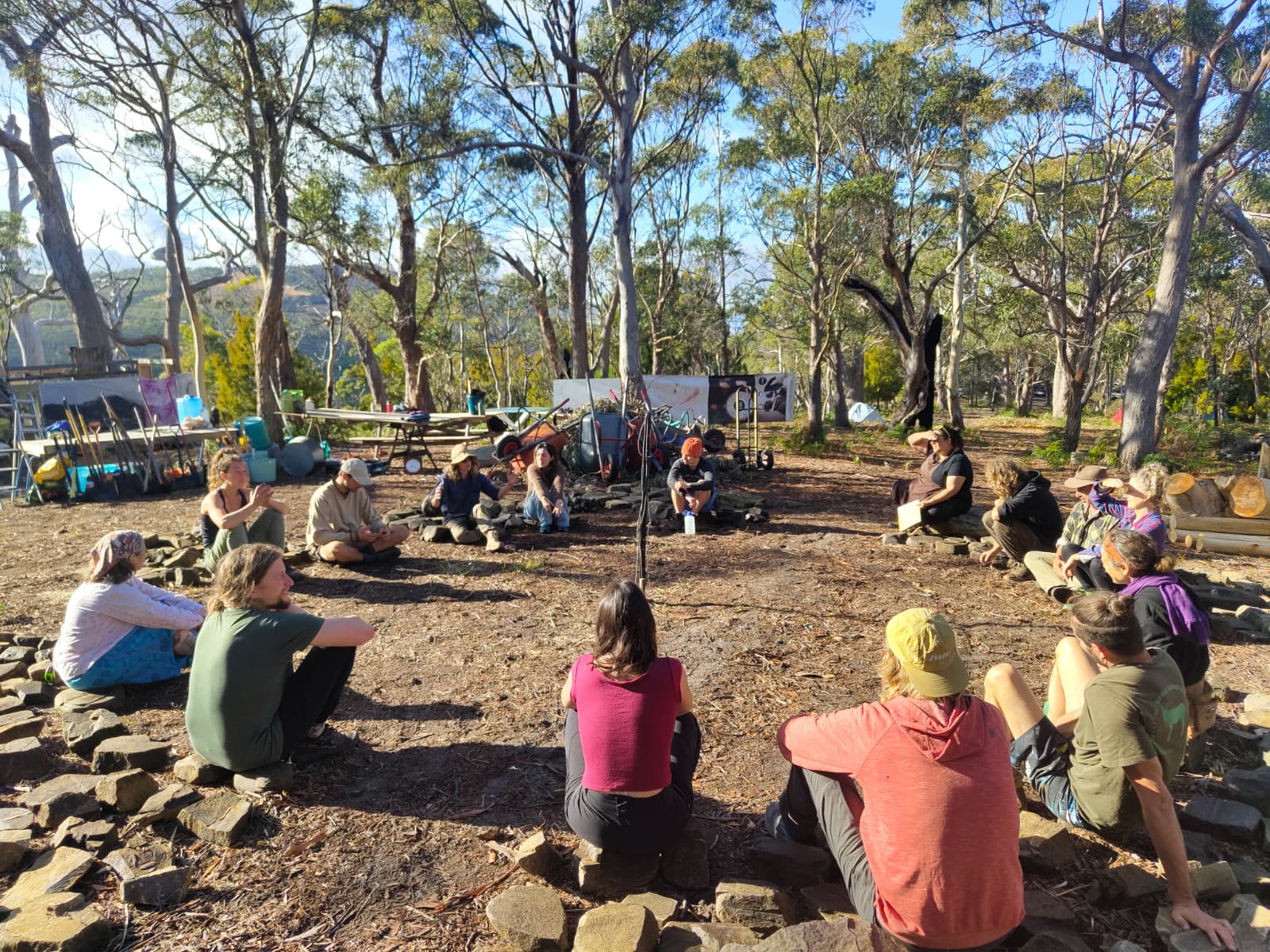
Tasmania, Australia Opening Circle, 2026
The 35-day Advanced Cob Building Workshop consists of 25 days (Monday through Friday) of learning & construction for 4 hours in the morning and 3 hours in the afternoon with theoretical instruction (lectures with graphics) on most Monday, Wednesday and Friday afternoons to complement the hands-on experience. Students arrive on Saturday and Sunday (no later than 12pm on Sunday) and settle in. The two meals offered on Saturday (dinner) and Sunday (brunch) are optional and an additional fee of $10 each. The Workshop begins at 4pm on Sunday and ends on a Sunday, 5 weeks later, after the morning Closing Circle & Brunch, around 2pm. Students can also arrive on Saturday to acclimate, if they are coming from far away, and will be asked to cover their own food needs, or pay the Host for the extra meal fees.
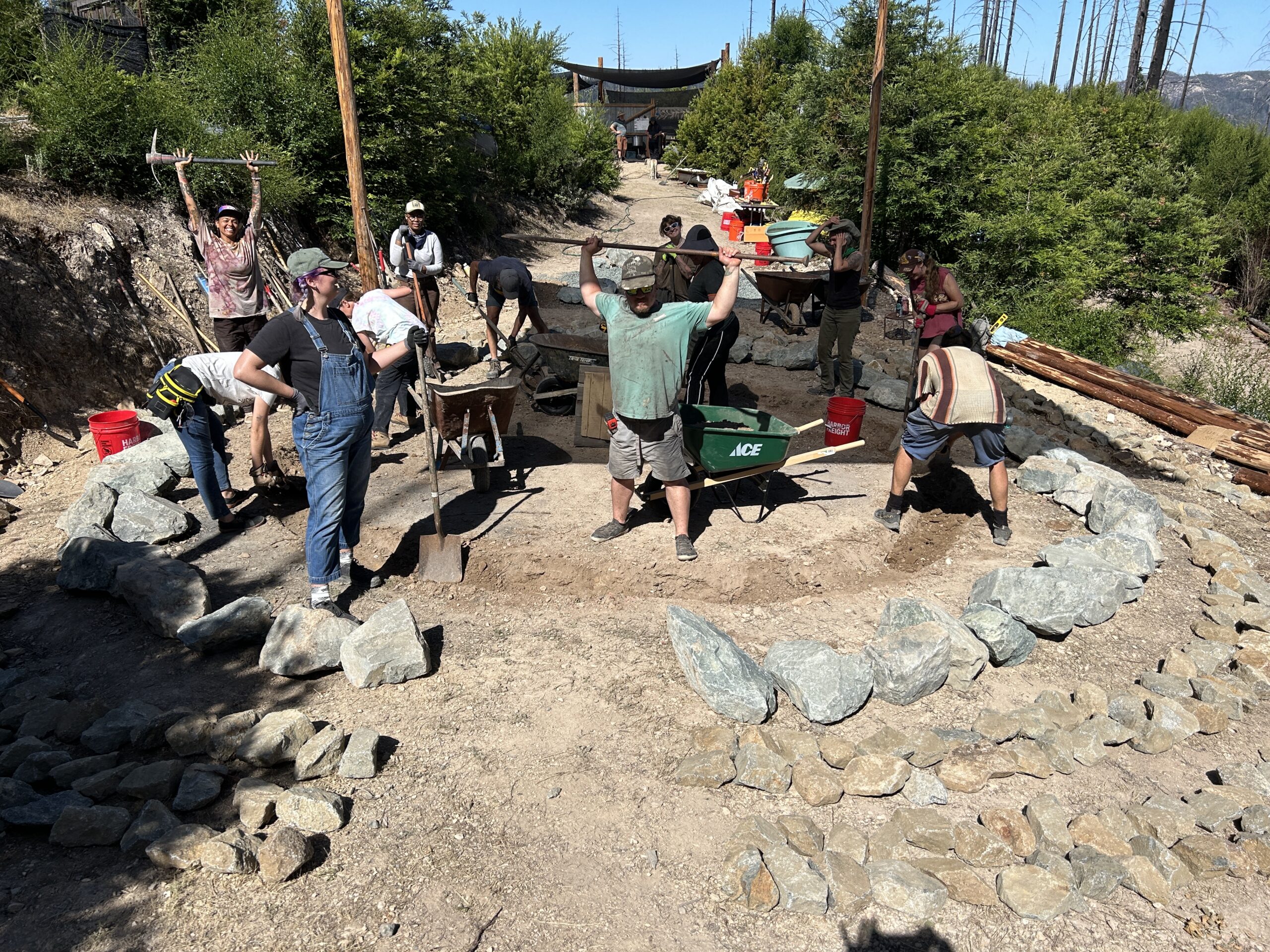
Trench Day in California, 2026
The Opening Circle begins promptly at 4pm, followed by a Host Site Orientation at 5:00pm, Dinner at 6:00pm and an Introduction to the Project by the Instructors at 7:00pm. We strongly require that students arrive Saturday before dark or Sunday by 12pm AT THE LATEST!!! We need to begin ALL TOGETHER, as the most important information for the success and smooth-running of the workshop and the well-being of the students will happen on Sunday between 4pm and 8:30pm. It is very inconvenient for students, Host, Instructors and the group, when someone arrives late and misses any of the opening sessions. Please be punctual because Monday morning we begin digging the trench for our Cob Building and students need to be prepared, well-informed and ready to go!!!! Following Breakfast from 7:30-8:15am, the morning learning/building session begins at 8:30 am and lasts until 1pm with a 20-minute snack pause at 11am. Lunch break is from 1pm to 2:30pm, which includes a rest time before the 3-hour afternoon session begins, from 2:30pm-5:30pm. Mondays, Wednesdays and Fridays there is a 60-minute lecture at 2:30pm, followed by construction time. Tuesdays and Thursdays students begin building again right af
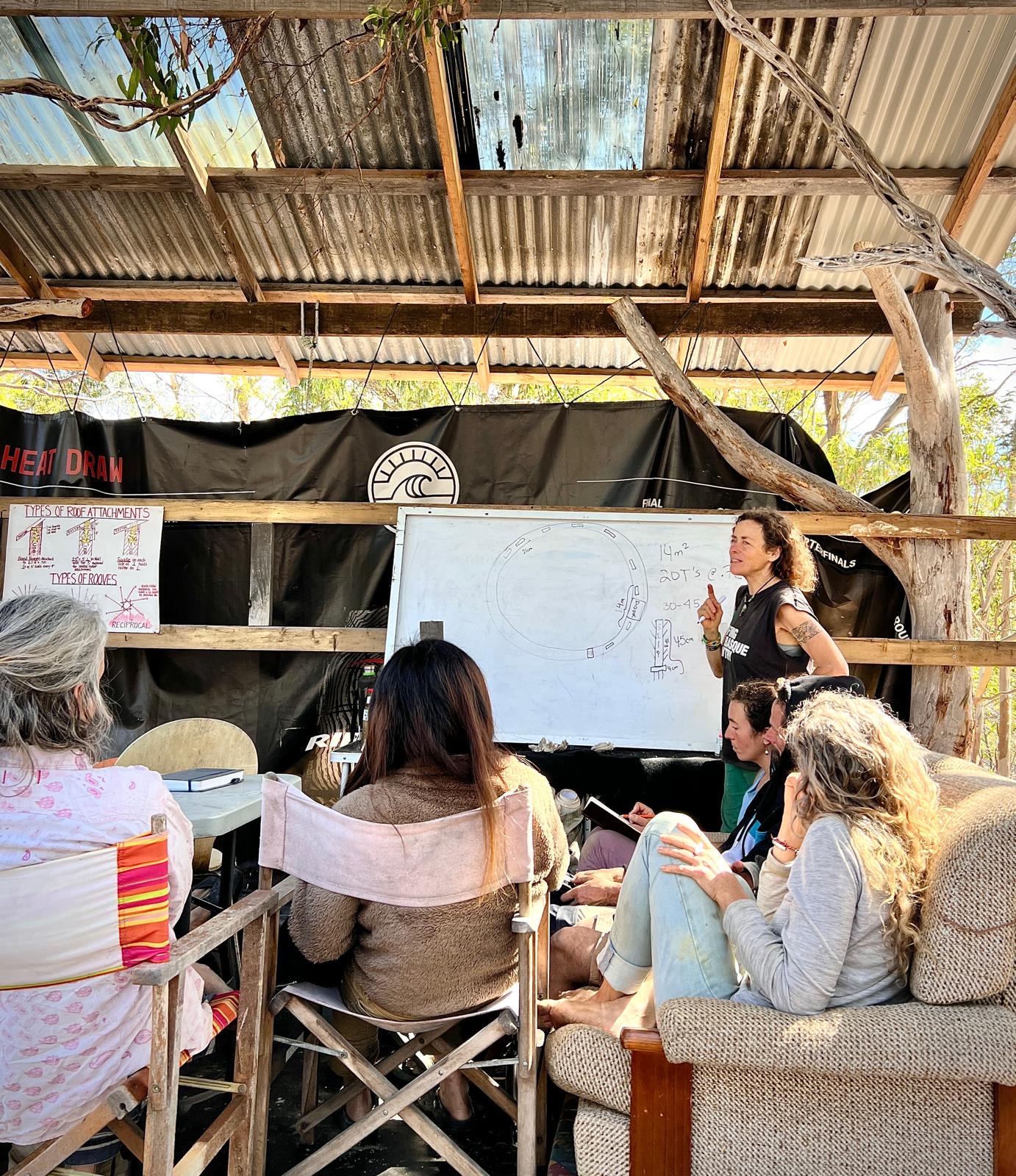
Lectures after lunch to support the physical work, Tasmania, 2026
ter the rest time. After class in the afternoon there is a 90-minute break before dinner (served from 7pm to 8pm), in which students are encouraged to stretch, do some type of relaxation/movement practice, go swimming, walking and just relax as they wish.
There is sometimes a student (or more) informally leading yoga and movement practice in the mornings or afternoons (depending on student preference). There will also be one evening per week (usually Thursday) throughout the workshop after dinner for showing slides, videos and having Course-related discussions. Other evenings, except Tuesdays, are mostly free and sometimes students offer informal courses in their specialties and passions. Tuesdays are reserved for our weekly Council Circle, where we do a deeper sharing and listening to attend to the inner worlds of our students, staff & Host(s) during this intense experience.
On weekends students are free to explore the area, rest onsite, and even continue building, subject to Instructor approval. While breakfast foods will be available on Saturday mornings for students to make themselves as part of the meal plan, the other weekend meals are provided by students who are welcome to use the kitchen. Our
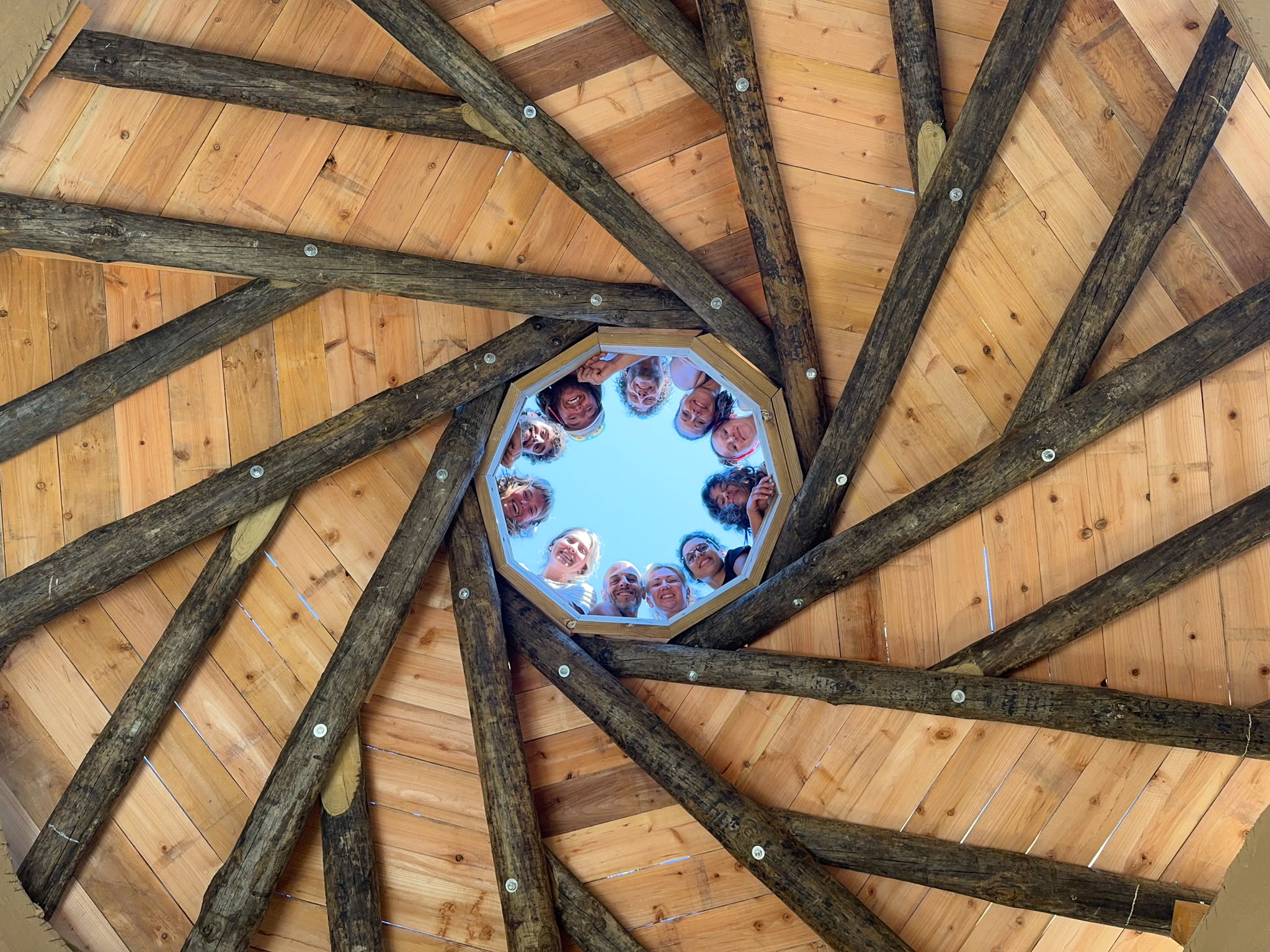
Finitoooo, Portugal, 2026
Hosts will be offering students a ride to the river on Saturday and Sunday mornings to get to town to get weekend food provisions and eat out if they wish (USD$7 for the complete trip). On Friday they will offer a ride to a swim spot to celebrate the end of the week, as a gift of gratitude.
The 35-day Course will offer practical learning by building a complete 14m2 curvilinear building from foundation to roof, as described in the “Project” section. Those who complete the 35-day Workshop will receive an Advanced Cobber Certificate of Completion for Foundation, Cob Walls (which includes Door, Windows, Shelves, Art, Niches, Bottles, Electrical Housing & Plumbing preparation), Floor, Plaster & Roof.
DAILY SCHEDULE
The daily schedule (subject to slight modifications due to location/climate/time of year) will be:
7:30-8:15 Breakfast
8:30-1:00 Class
1:00-2:30 Lunch
2:30-5:30 Class (Lecture on MWF)
5:30-7:00 Rest/Yoga
7:00-8:00 Dinner
8:00-9:00 Council Circle (Tues) & Slides/Videos/Discussion (Thurs)
Students are expected to be on time and participate in all sessions and required activities as the goal of building a full construction depends on the whole group working together!
COURSE CONTENTS
Students will learn every phase of building a cob building from foundation through the reciprocal roof in hands-on building and lectures/theory. In addition to the lectures, slideshows and videos will be shown to support and enhance their understanding of cob materials, cob building, design, geography, budgeting, business options and legal issues.
Our hands-on practice will include:
digging foundation trench
pouring gravel and inserting drainage pipe (if applicable)
building foundation stemwall
analyzing soils and materials
making test bricks
deciding on correct mixture
deciding on best location
making cob w/ partner and solo
building with cob
preparing and inserting the door
preparing and inserting fixed and opening windows
preparing and inserting shelves
inserting bottle windows, glass and other objects
inserting electrical housing and outlet/switch boxes (when applicable)*
insert PVC pipe for plumbing in walls (when applicable)*
sculpting
preparing and applying earthen plaster (1 coat)
pouring an earthen floor (2 coats)
preparing walls for roof connection
building reciprocal roof frame
putting on roof sheathing and other elements
installing impermeable liner and green roof components
making small-scale cob designs of future projects (time permitting)
In addition to Cob Building practices, the Course material also includes:
legal cob construction practices & the international cob code (Appendix AU in the IRC)
cost analysis
creating a cob business (building/teaching)
assisting, building and teaching with CruzinCobGlobal
*While the insertion of electrical housing and one or more outlet/switch boxes and PVC pipes to hold plumbing are always included in the workshops, the simplicity or complexity depends on the host’s design and preferences. There will be no electrical wiring or plumbing pipes installed during workshop. That is beyond the focus of this course and requires professional experience and certification/licensing.
REQUIREMENTS & IMPORTANT INFORMATION
Students will need to come prepared for demanding physical work from Day 1.
This includes bringing:
Work clothes appropriate for the country and climate we are in
Work boots or other closed-toe shoes (for foundation and roof)
Flip-flops or Crocs (for cobbing/plaster days)
Rubber dishwashing gloves (for lime mortar)
Work Gloves (for stone work)
Tool Belt
Tape Measure
Box Cutter
/Straight Edge
Wood Hand Saw with medium teeth (cheap)*
Level (2ft)*
Hammer*
Japanese plastering trowel(s) (order online)
Basic pointed steel mortar/plastering trowel
Ear Plugs (roof week)
Safety Glasses
Wood Chisel*
4”-6” Diameter Round Plastic Container Lids (for plastering)
Good Moisturizer
for Hands & Feet
Hat
Sunglasses
Water Bottle
Notebook/Pen/Camera
Carpenter Pencil & Sharpener
Sample of your Soil (optional)
Any other power tools like circular saw, grinder with metal blade, cordless drill, chop saw, extra hammers, trowels, saws, levels…will be very welcome if you have them and are driving in. Some students fly in with only carry-on luggage and can’t bring some of these tools.
*These tools will be very helpful to bring if you can, to minimize sharing and waiting, but if you can’t the Host will provide them.
***PLEASE MAKE SURE TO READ THIS IMPORTANT INFO!***
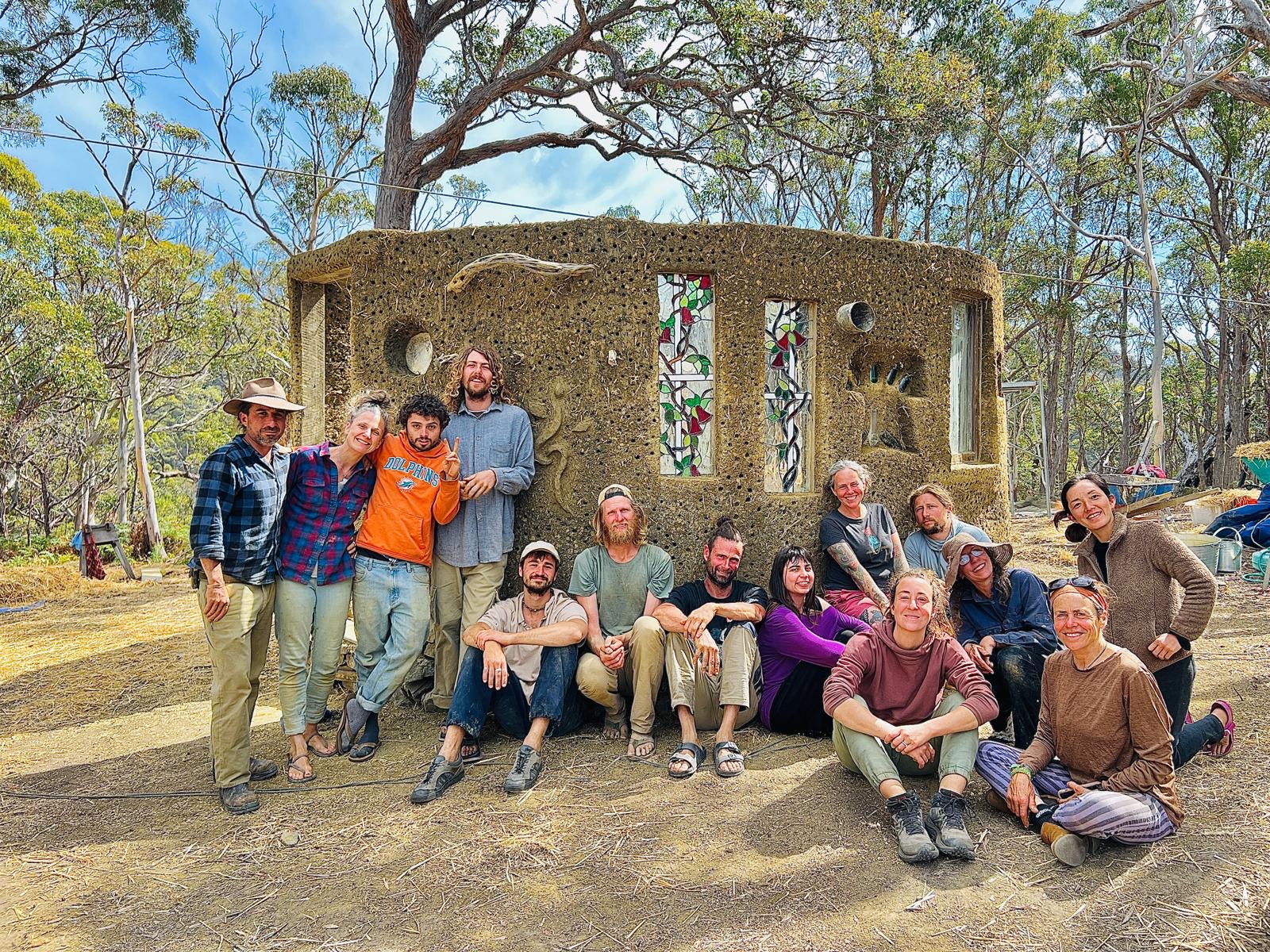
Takes a village to build a foundation and put up a cob wall in 2.5 weeks, Tasmania, 2026
Everyone is essential to the completion of the build! These workshops are designed for people that want to learn how to build a complete structure from start to finish in a professional manner and amount of time. They are very intensive and, while we make time for yoga, stretching, dancing, music, relaxing….all students are expected to be present and participating in all building and lecture learning hours, unless absolutely incapable due to illness or have some other significant/emergency reason. This is because we design the size of the building and organize the structure of the workshop in accordance with the number of students and when people are absent, it impacts the whole group and the other students have to work harder and it disturbs the integrity of the group. It takes the whole village to see the building through from start to finish! In addition, Instructors set up building work according to students’ strengths and learning needs. In short, if you don’t feel that you will be able to b
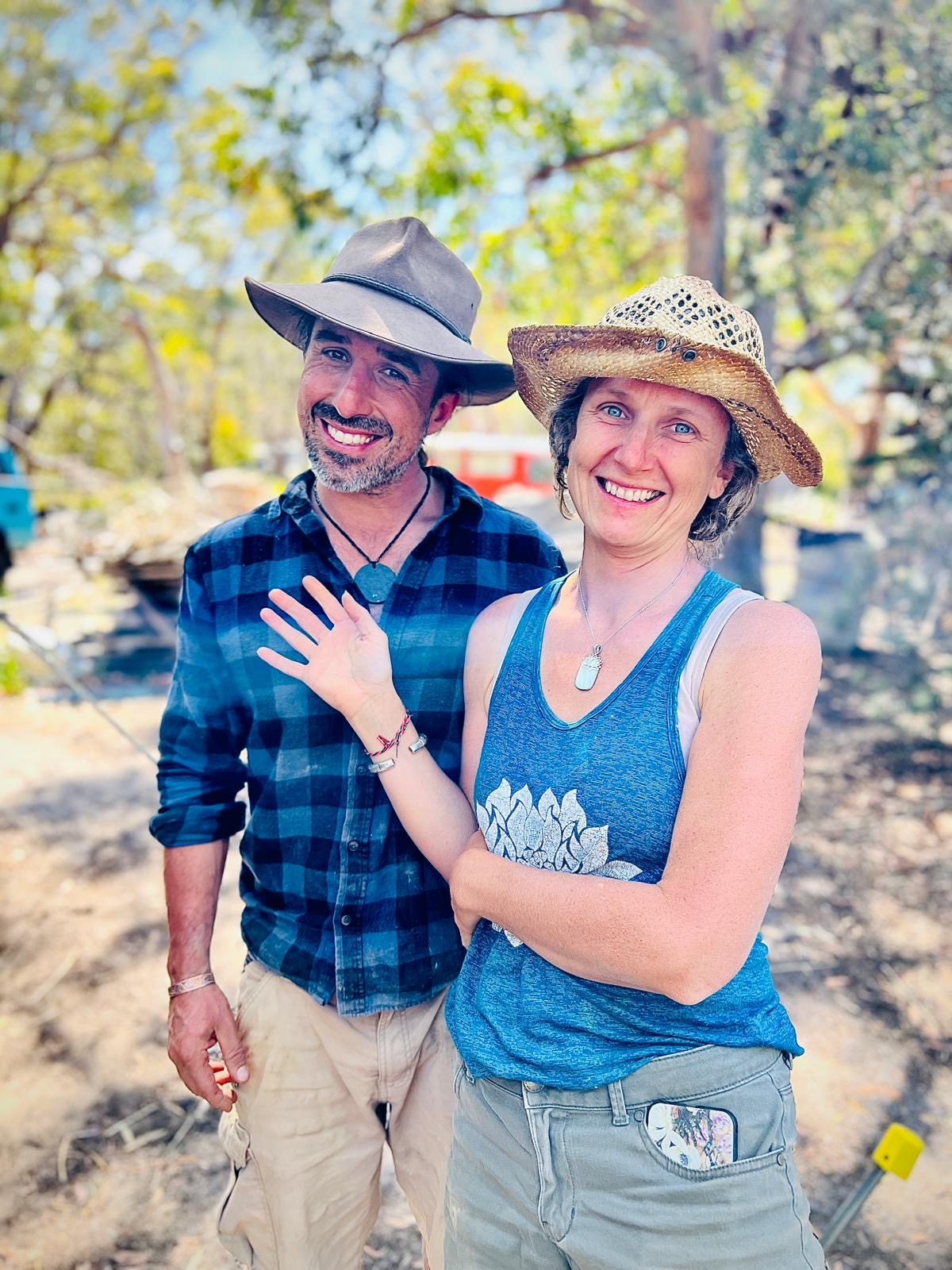
Experience on the left, no experience on the right…everyone is welcome and everyone counts towards reaching the end goal! Tasmania, 2026
e present every day for every session, please re-think your readiness for our Advanced Cobber Training. While you do not need to have any prior experience with building, we attract serious and highly-motivated students! So if that’s you, you will be surrounded by others with the same desire to learn and build! Everyone has a role every day all day!
We need and depend on everyone’s full participation in each day of the workshop. This is a total group effort on all levels: physically, mentally, emotionally and energetically. If someone is physically absent from the site and lectures due to illness or other urgency for more than one full day, they will need to make up the days missed in a subsequent workshop to receive the Certificate (only paying food costs). If physically injured or ill (and capable), it is requested students still be present at the site and for lecture and other required evening activities, so as to not miss out on information and keep learning by observation, and thus still qualify for the Certificate.
The workshop intensity changes from week 1 to week 5 with the focus of the week. The first foundation week breaks people in with the work of moving, lifting, rolling and placing rocks and is a new and demanding physical and mental experience for most students. It also includes
the first layers and coat of cob floor. The second week and part of the third week of cob-making and building are similar to the rock foundation week in physical demand, but are more flowing, multi-faceted and cardiovascular in movement. On Thursday & Friday of week 3, the workshop takes a turn and slows down and the body can rest as students connect with their creative source now to design sculptures and beautify the walls around niches, shelves, windows, etc. This is a very special rewarding experience and time of the workshop, decorating the walls with personal meaning as expressed by each unique student. Usually there is an overarching theme decided on by the Host(s). Plastering follows sculpting and is another enjoyable more lightweight physical experience, that lends itself to talking and sharing at
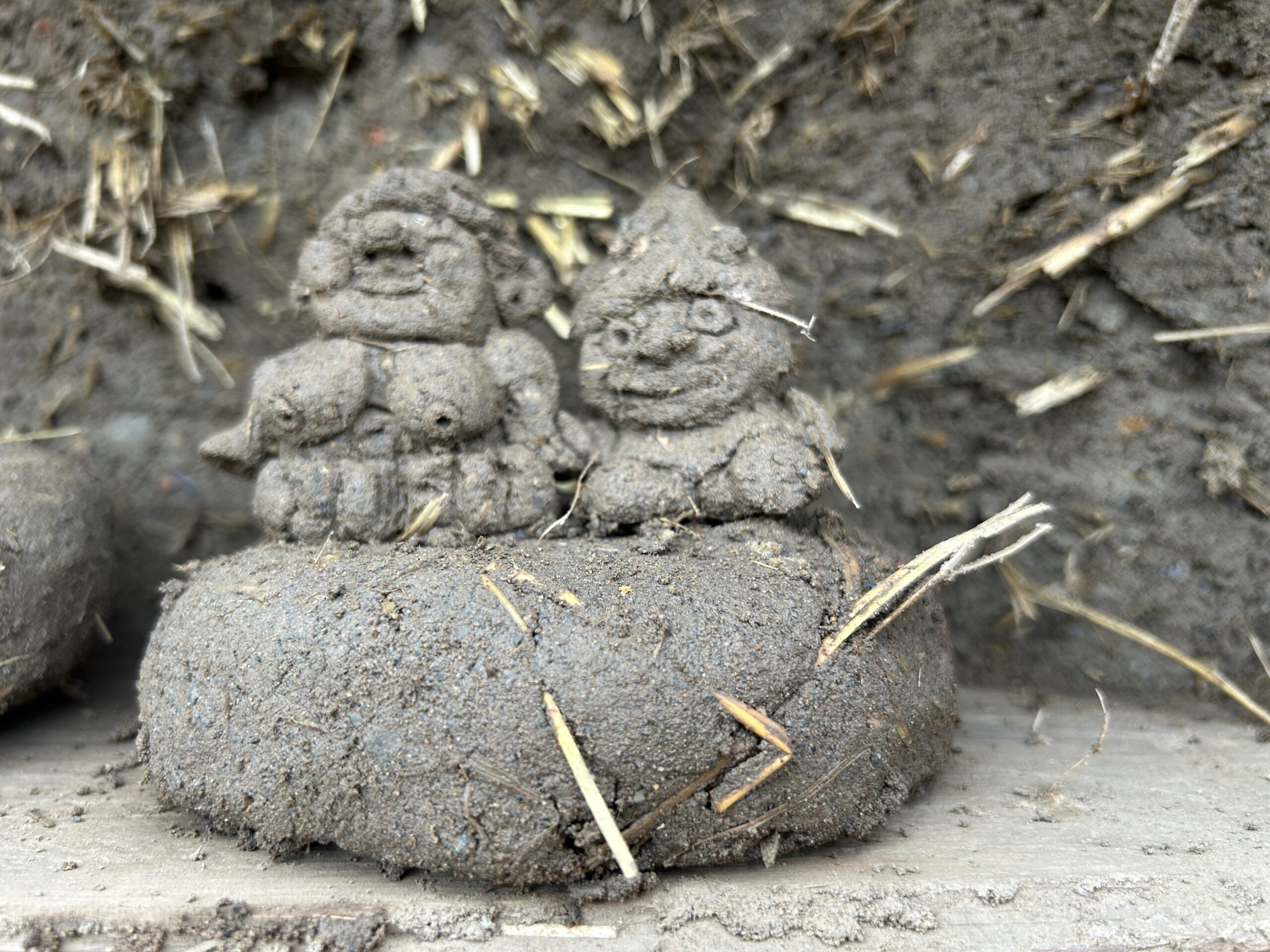
Sometimes it’s this!
the wall in a meditative rhythm, as the students have bonded and shared deeply through a variety of experiences for a month. On day 5 of week 4, after the wall has been plastered, the roof begins. This part is the beginning of a change of pace from the earthen building work to carpentry skills, power tools, measuring, sawing, drilling, hammering, screwing, trimming, etc. But now the workshop is in its final stretch and there is a boost of energy to wrap up the roof, close the top of the wall, and tend to finishing touches….the grand finale!
For students wanting a more mellow slow-paced cob experience, along with time for personal exploration and experimentation following their own rhythm, these workshops are not for you! However, you can find a more suitable workshop online with other organizations that offer a shorter period, focused on building a garden wall, a bench, a compost toilet or some other smaller scale project.
Students are required to read “The Hand-Sculpted House” and “Essential Cob Construction” (see website Resources page) before the workshop begins, and any other books they find or are listed on our Resources page, ideally on plastering and reciprocal roof building. We ask that you watch the many videos on our our “International Cob Workshop” playlist on Claudine’s YouTube channel, the new educational YouTube series “Building a Mud Home” by Cooper Green, posted on the Natural Buildings channel and created from our North Carolina workshop footage, and the ones posted on CruzinCobGlobal’s website , to get an idea of what is expected. Also it is a great idea to watch as many other videos on cob and reciprocal roofs as you can to come mentally prepared. Please bring your book(s).
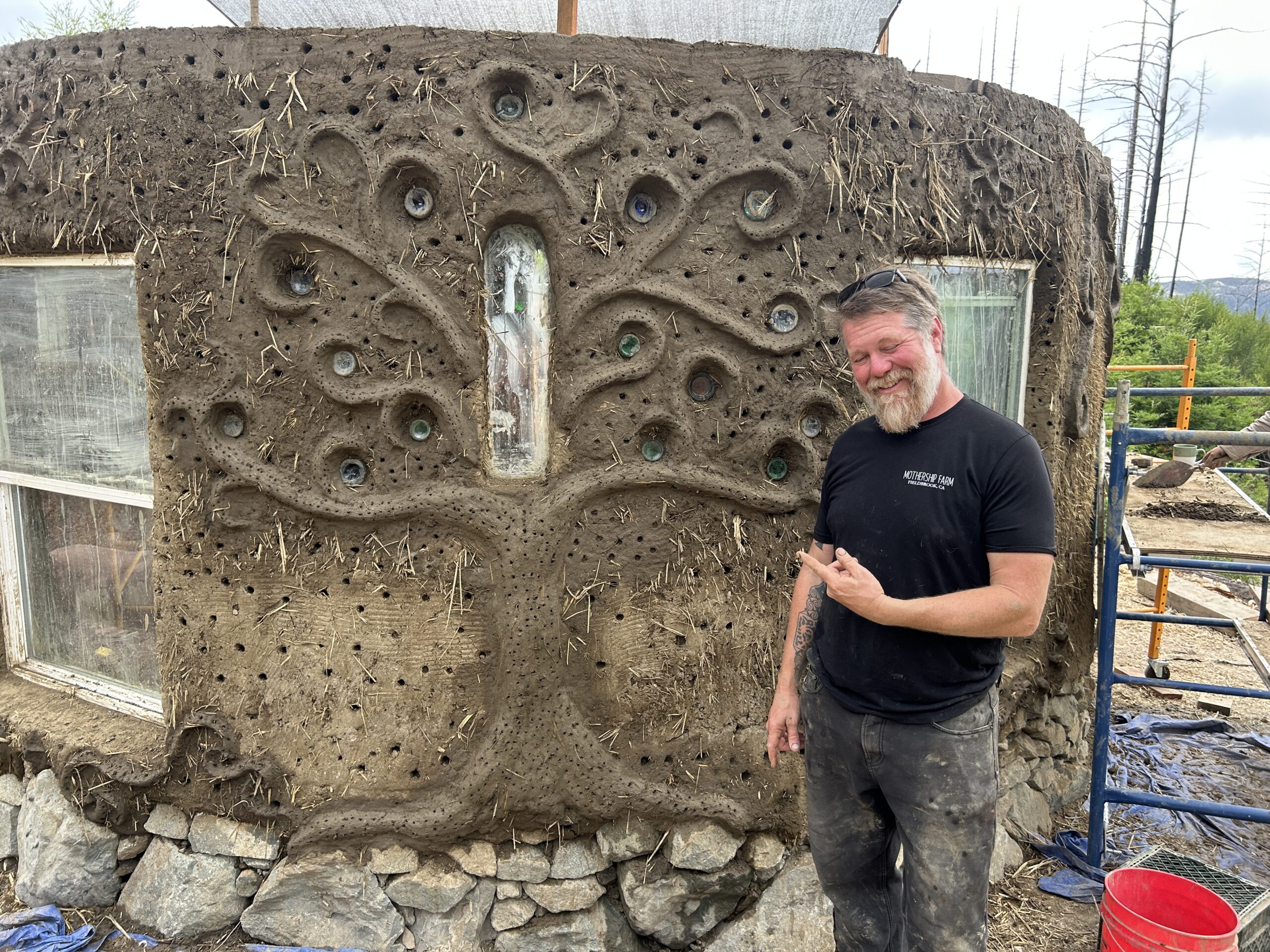
Happy Host in California, 2026
Students must tend to their own personal needs, drink alot of water, rest when needed, and exert themselves at a steady pace. Students who cannot do the strenuous physical work should let us know when registering, so we can make sure the workshop is a good fit. If approved before the workshop begins, we will aim to adjust appropriately. There is alot to do to support making and building with cob, while respecting your physical limitations!!!
Finally, please bring a watch or use your phone to be prompt and ready for each part of the Course, including mealtimes. Please make sure you share your dietary restrictions/allergies with CCG in your registration form. Note that very demanding dietary needs will not be
able to be met (vegan & non-gluten ok) and those students may be recommended not to participate, unless they are willing to meet their special needs on their own, which will not include kitchen access on weekdays. Please discuss with Claudine at time of desire to register. Also please bring your essential snacks and foods, pillow and whatever you NEED to be comfortable and happy. Feel free to also bring playlists, speaker, slides, videos,
movies and books to share, as well as a sample of your soil to test.
We look forward to opening you to a whole new world of experience, skill, growth and transformation as you bond with your new COB family for life!
MEALS & ACCOMMODATIONS
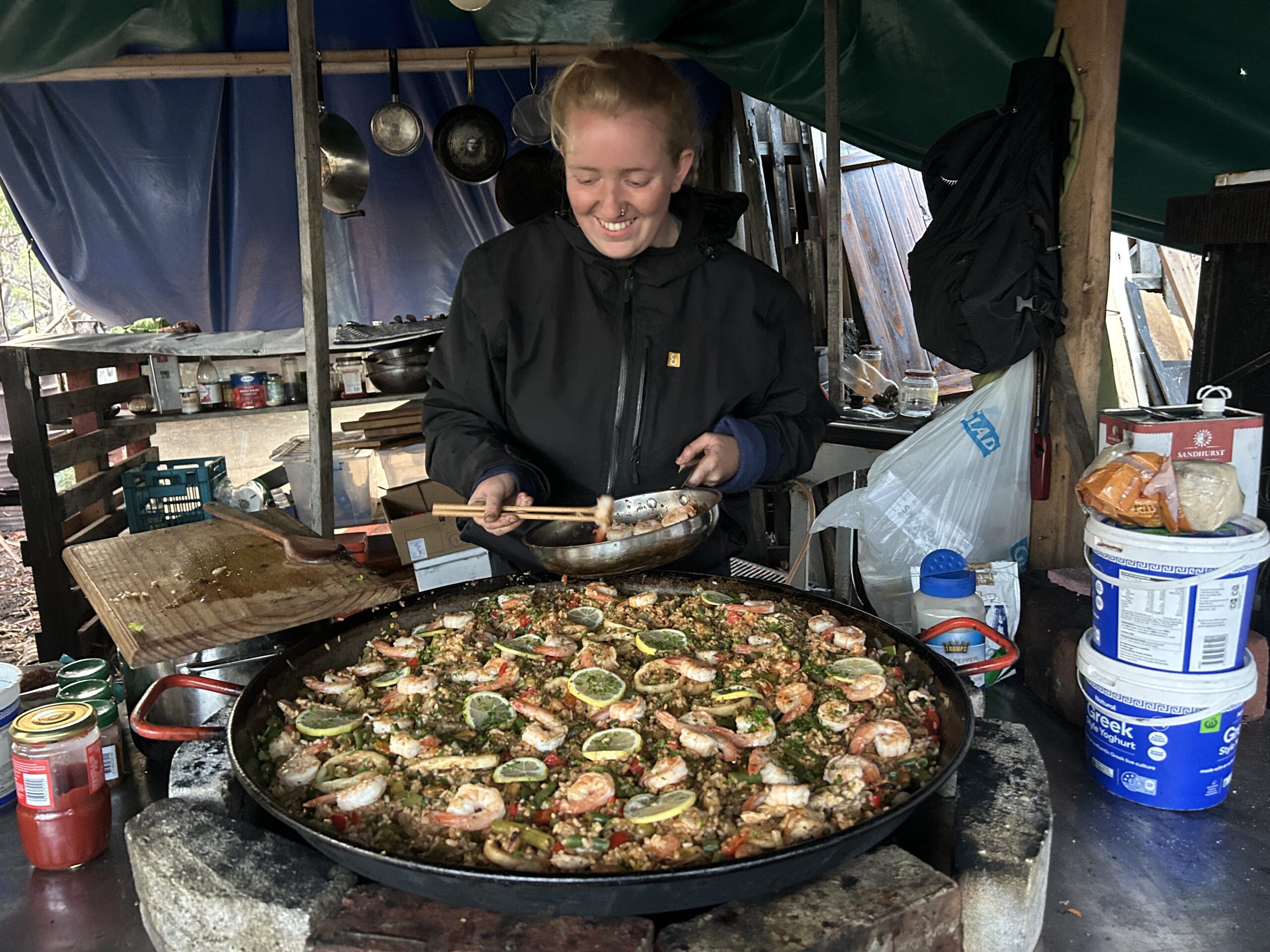
Paella in Tasmania, 2027
We will serve three meals a day from Monday through Friday, do-it-yourself breakfasts on Saturdays, the Welcome and Celebration Dinners, and Farewell Brunch. On weekends after Saturday breakfast, students will be on their own for food and may use the onsite kitchen. Meals will be vegetarian and locally-based as much as possible, including some yummy farm products! Carnivores, pescatarians & omnivores will, if desired, be offered non-vegetarian options of meals a few times a week and/or supplemented with canned fish, dried meats, cold cuts. They are also welcome to buy or bring their own supplements.
We will attend to vegan and gluten-free diets if needed, but any other restrictions & allergies that require extensive preparation needs, will probably not be able to be honored, and kitchen will only be accessible on weekends for students.
Please come equipped to camp with lightweight sleeping bag and tent or hammock. More detailed information will be sent a few weeks prior to workshop start date.
INSTRUCTORS
Tom Van Well, Cob Instructor
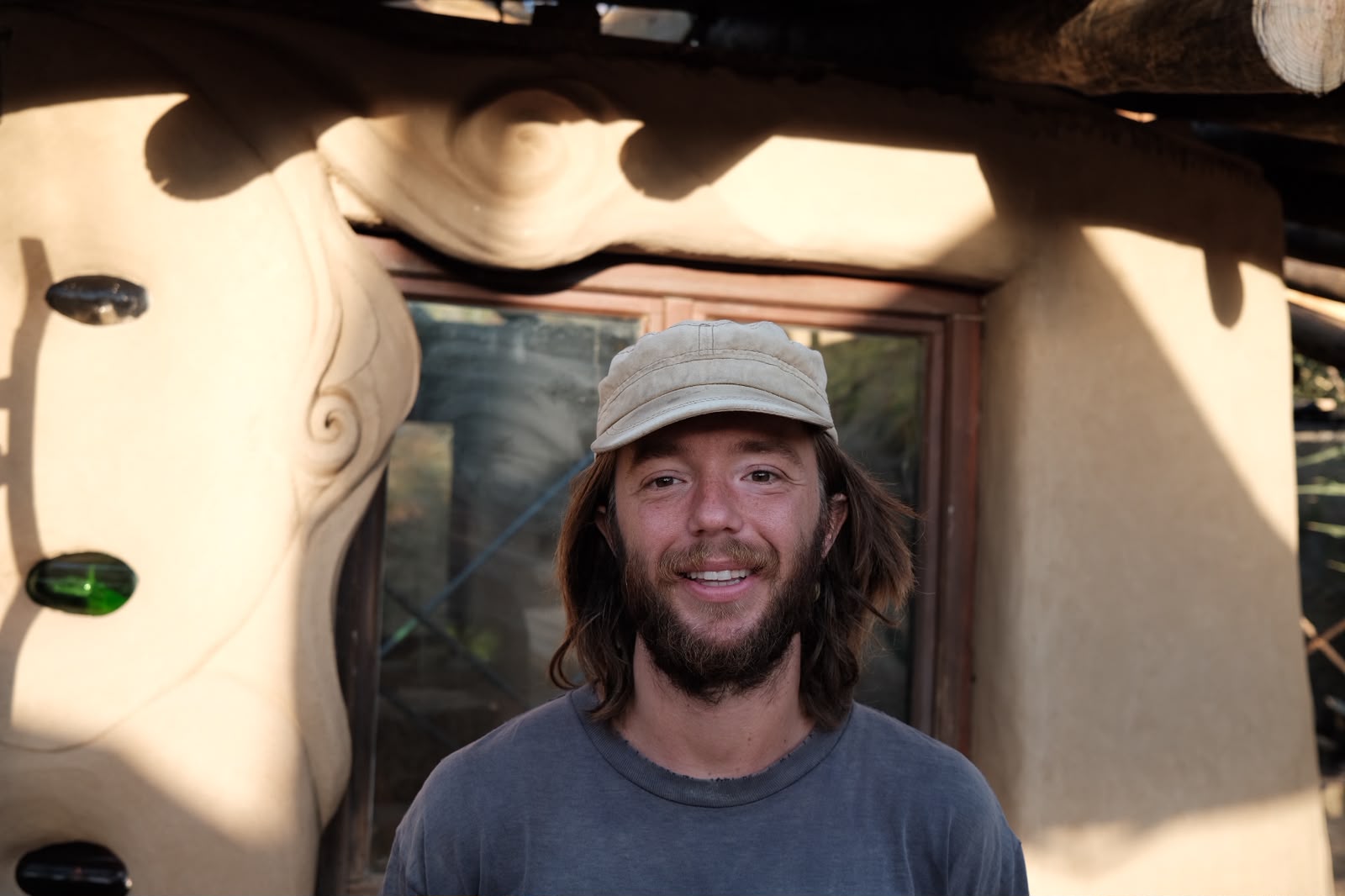 Hello fellow COB Lovers!
After living on farms for some years in my early twenties and getting in touch with natural building, I set off to my first CruzinCobGlobal workshop in the summer of 2022 in the Azores, where we built a beautiful oven with a bench. A few months later I travelled to the US to take a proper 5-week Full Build Workshop and became hooked on Cob and the whole workshop experience. For me, this was the start of a muddy journey that could not have turned out better! COB and my work with earthen plaster have taken me to many places around the world to create and meet the most amazing pe
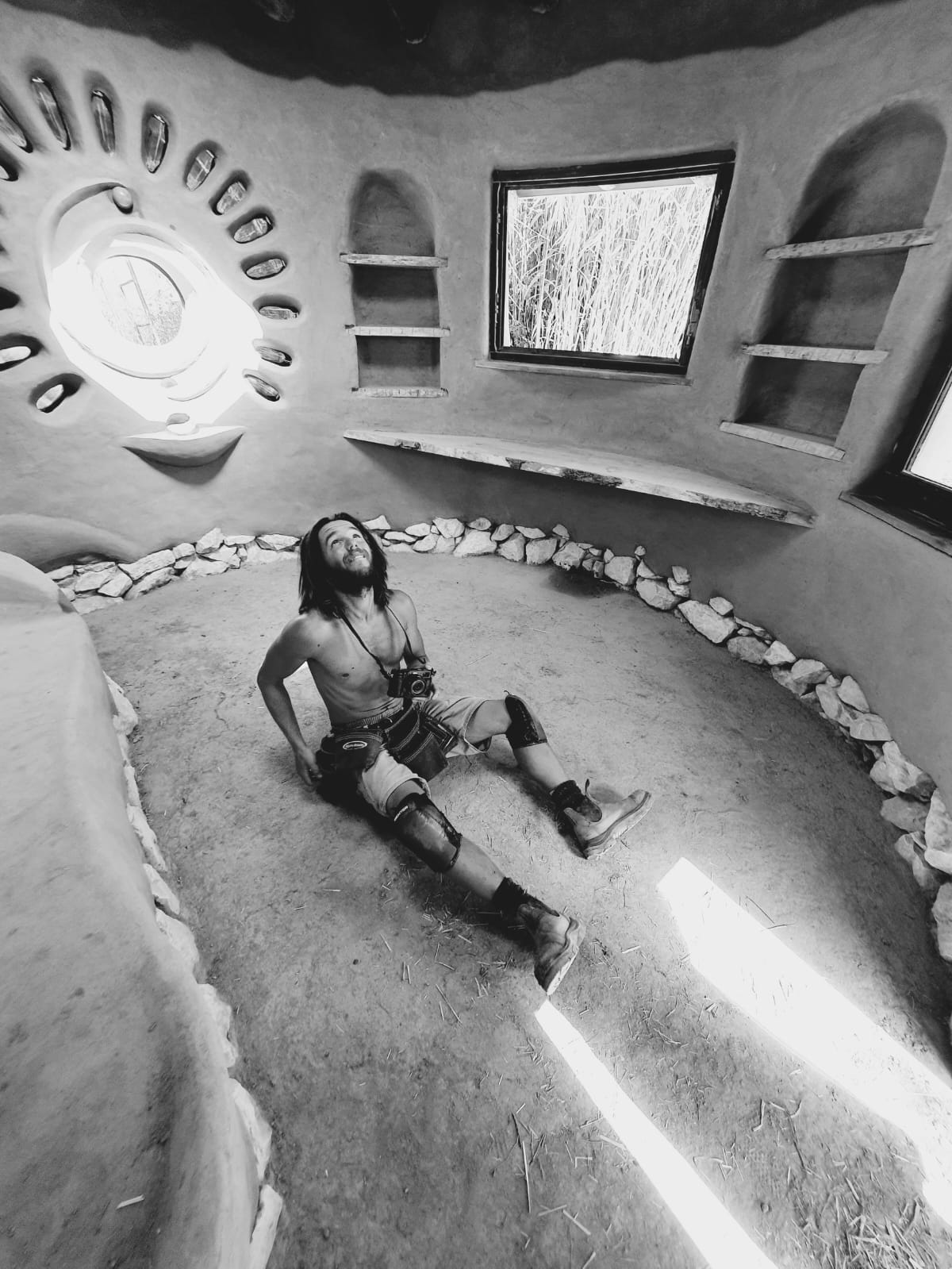
In awe and bliss at the finished product at his most recent workshop in Coruche, Portugal, 2026
ople, many of which are either colleagues or friends at present. In addition to teaching CCG workshops in Puerto Rico, Portugal and now Colombia, I continue to expand my interests and knowledge and skills in natural building, notably timber framing, light straw clay, landscape architecture, adobe, hempcrete and last but not least, my big passion: plaster. Plaster has become my main focus, for which I have found myself traveling far and wide, following my curiosities all the way to spending months in Japan studying with Masters of the trade. I love to spark a curiosity in people to start asking questions themselves. Understanding that mistakes are inevitable, and with the right mindset, solutions are too. My aim is to bring this with me in whatever I do, wherever I am, also in the workshop with you! All of the topics this workshop touches upon are universes by themselves, and I’ll give nothing but my best to guide us safely through these 5-weeks. In my experience, connections made in the clay are strong ones, I look forward to creating and connecting with you! Hasta pronto en Colombia!
Dorian Decker, Cob Assistant
Hiya! My name is Dorian Decker
I grew up in rural Northern California and have been a conventional construction worker most of my life. After I 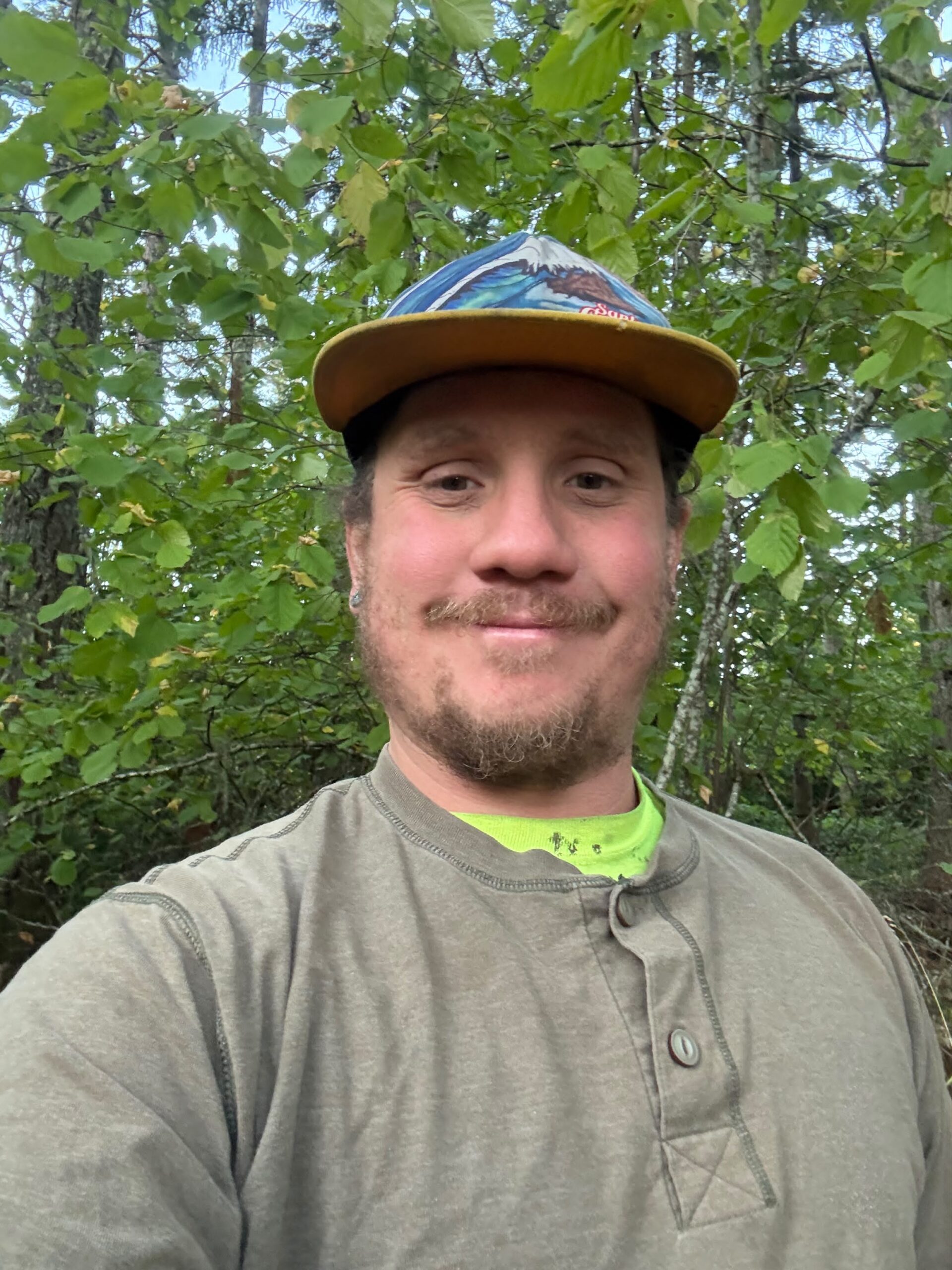 moved to the Pacific Northwest I started taking cob workshops and I’ve never looked back! I have learned cob building under teachers like Bryan Burnoski with the Sundog School of Natural Building, Allie Maggio with Soulcraft Natural Builders, Sasha Rabin with Earthen Shelter, and most recently Claudine Desiree with CruzinCobGlobal.
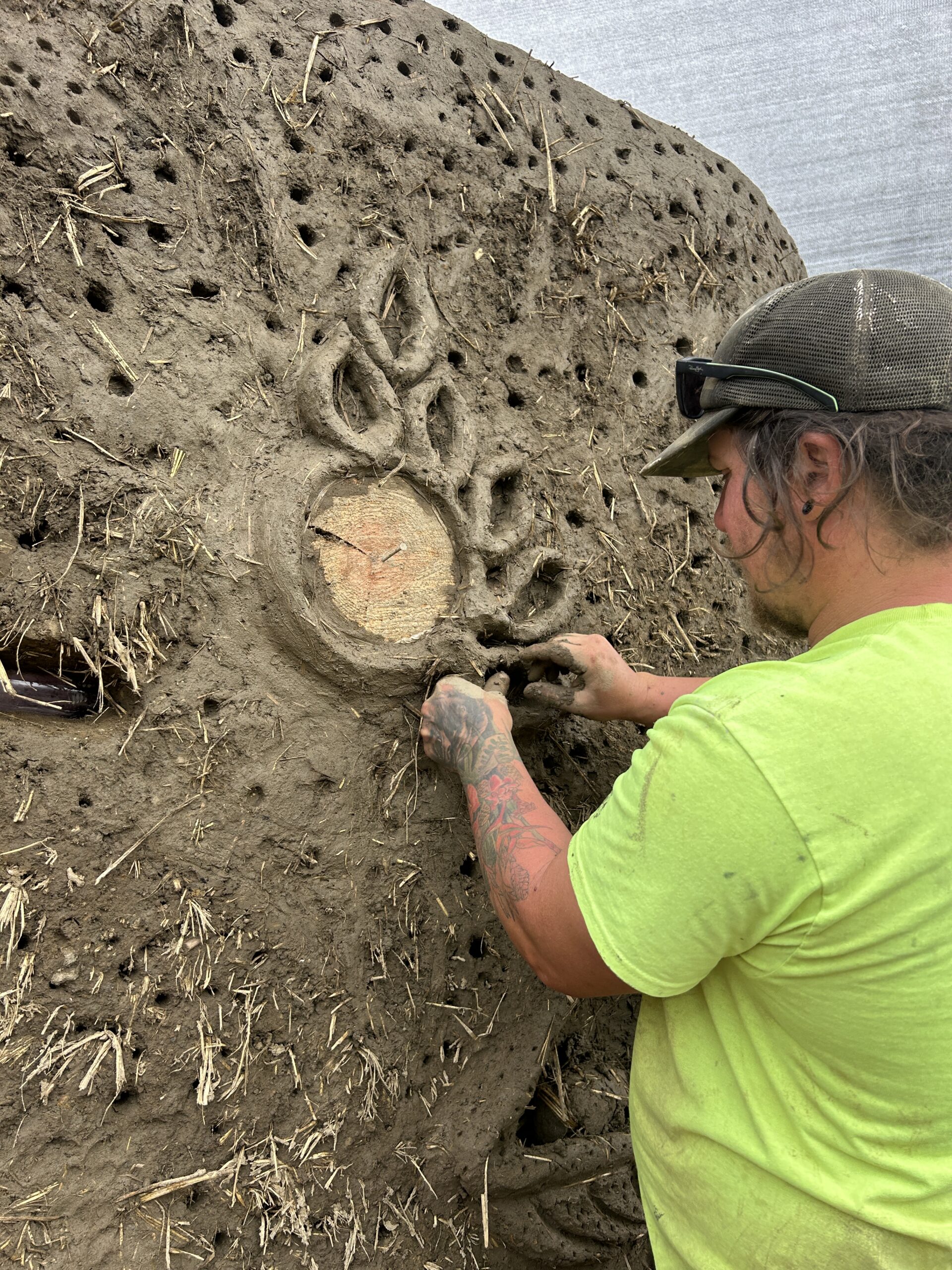
Loving the sculptiong after the hard work of building walls!
Then, with all I learned, I worked as a teacher’s assistant for cob workshops at the Lost Valley Educational Center while gaining experience building cob cottages, walls and ovens.
Not only is building with cob accessible, affordable, and sustainable, it also takes us back to our human roots as an ancient building technique, further connecting us to nature and to each other.
In addition to playing in the mud, I also enjoy surfing & snowboarding, foraging, hanging out with my dog, playing music, and splashing around in bodies of water! Outside of being a cob instructor and student of the earth, I primarily work as a contractor and a carpenter and consider myself a Dorian of all trades! Really excited about assisting Tom in Colombia and practicing mi español!
TRANSPORTATION
Students coming from abroad should fly into Bogotá (BOG) with a second flight to Puerto Carreño (PCR) on Satena Airlines. Tickets should be purchased as soon as you register for the workshop to get the best rates. Again students should arrive onsite no sooner than Saturday January 23 and plan their departure on Sunday February 28 or Monday, March 1, unless otherwise agreed on with Hosts. There will be two transports organized for students, one on Saturday and one on Sunday, to the workshop site, as well at the end of the workshop.
REGISTRATION & PAYMENT
Very Early Bird Rate: $2500, paid in full by November 12, 2026
Early Bird Rate: $2600, paid in full by December 10, 2026
Standard Rate: $2700, paid in full by January 7, 2027
We are offering 4 work trade positions which give you a $250 discount for working one hour each weekday from 6:30am to 7:30am either on the site prepping materials and other work as guided by the Instructors or preparing & putting away breakfast. Two persons for each service. These are the first options to go. Depending on when you pay in full, the discount is taken off the appropriate amount.
Payment in USD can be made using Zelle, Paypal and Venmo to claudinedesiree@gmail.com. Europeans and other international students can pay in Euros at the current conversion rate using the Wise app/website using same email. You can also use this link for a free transfer up to 500€: https://wise.com/invite/ihpc/claudined
Please contact claudine@cruzincobglobal.org or Whatsapp +1(831) 212-7225 to register and ask any questions.
To hold your spot (there are 12 for new students and 3 for returning students), you can make a 50% deposit. The balance owed depends on the date of payment in full. Final payment deadline is January 7, 2027.
CANCELLATION POLICY
Students who have paid and cancel by November 24th, 2026 can get a full refund minus a 5% administrative/inconvenience fee on the amount they have paid.
Students who have paid and cancel by December 24th, 2026 will not receive a refund. They can receive a credit for a future workshop within two years minus a 10% administrative/inconvenience fee.
Students who have paid and cancel after December 24th, 2026 will not receive a refund or credit unless they have proof of an emergency situation or other reason out of their control, in which case they will receive a credit for two years minus the 10% admin fee.
SEE YOU IN THE MUD!